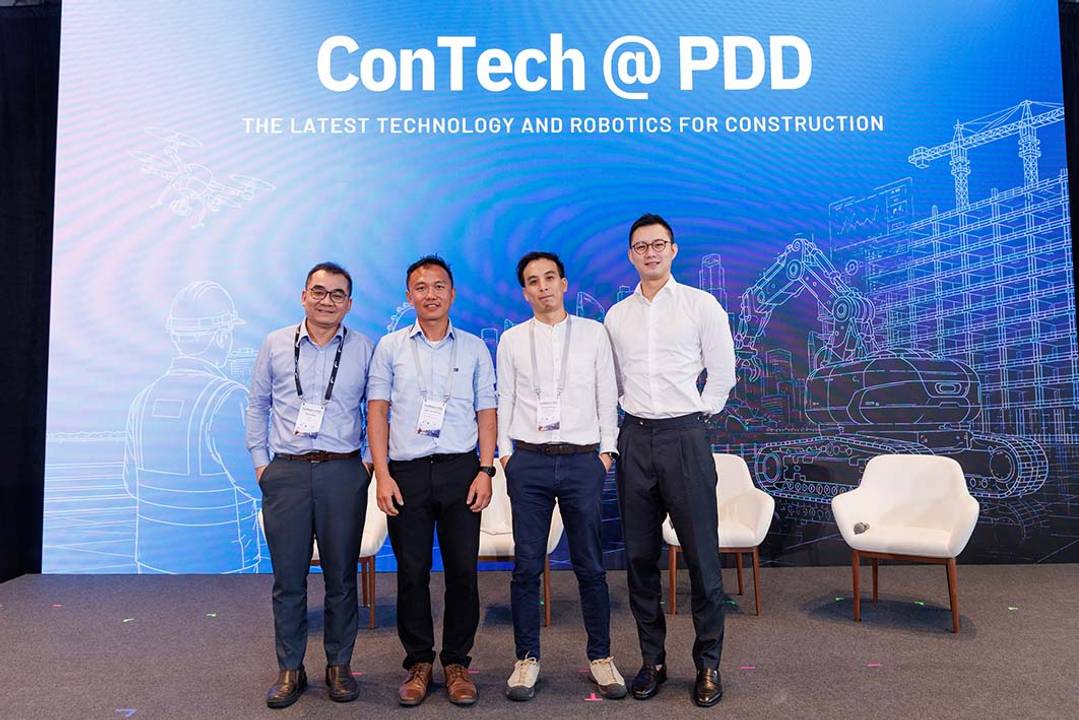
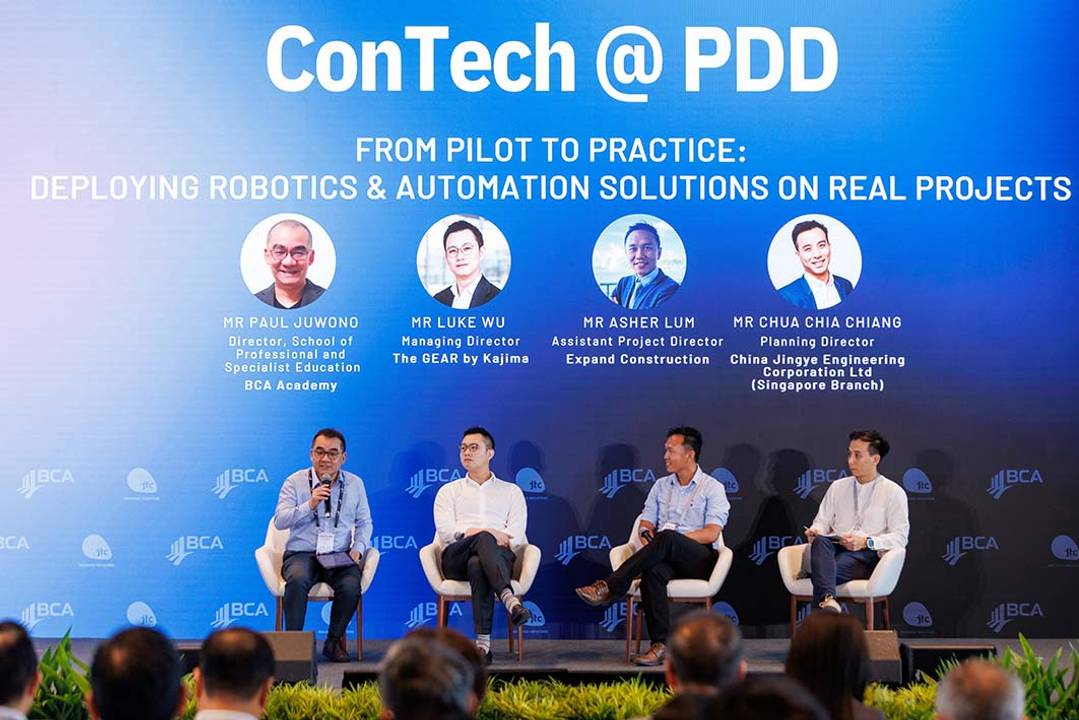
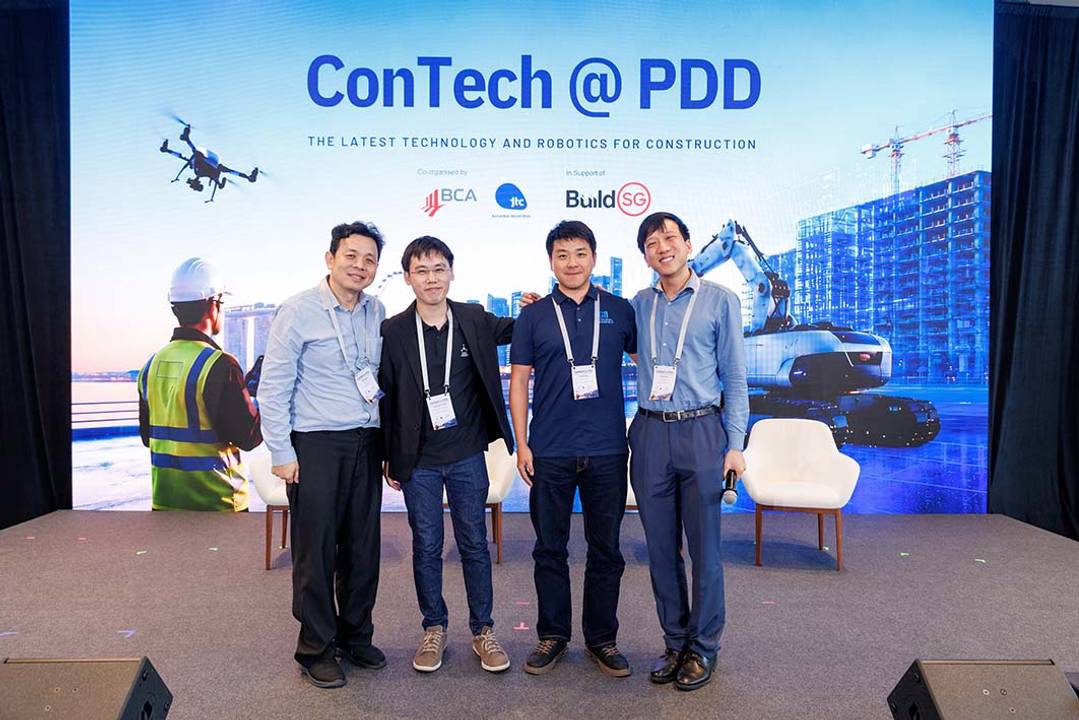
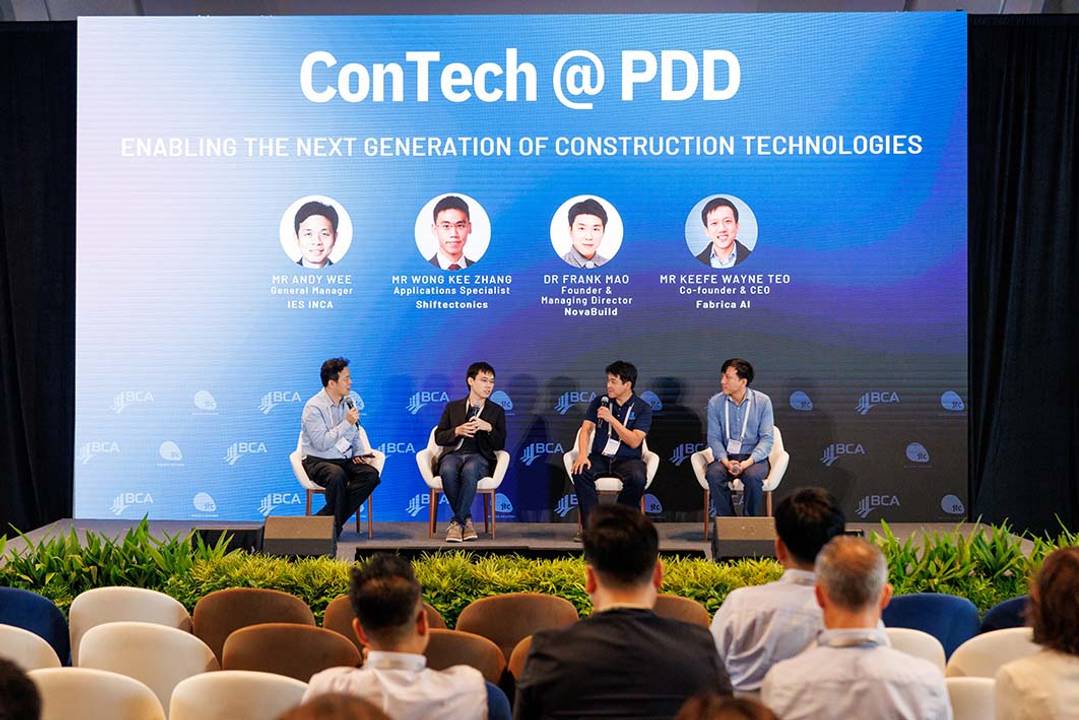
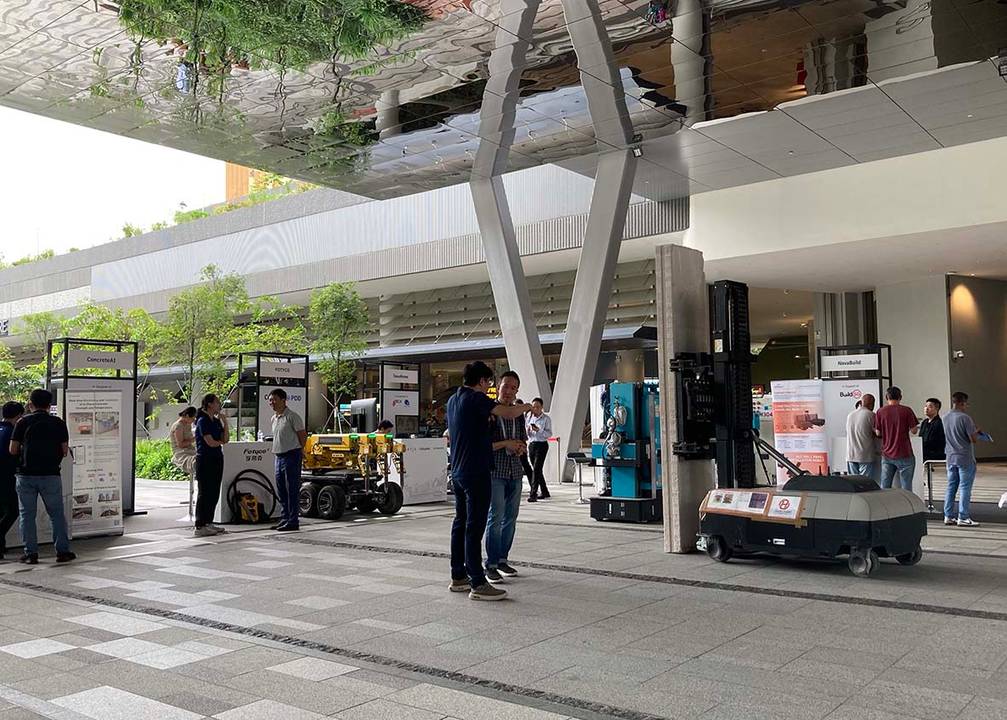
Co-organised by the Building and Construction Authority (BCA) and JTC Corporation, the Construction Technology @ Punggol Digital District (ConTech@PDD), held on 17 July 2026, brought together Singapore’s government agencies and industry stakeholders to share their robotics & automation (R&A) adoption journeys, discuss the challenges and opportunities ahead, and showcase practical solutions. [View the story on government agencies here.]
R&A deployment on major projects
Singapore-based contractor Expand Construction is an early adopter of R&A technology. The company has deployed its solutions at NS Square, a S$600-million development delivered by a workforce ecosystem comprising more than 800 personnel.
The project is being carried out “within one of Singapore’s most complex operating environments,” revealed Asher Lum, assistant project director at Expand Construction. This led the company to realise that traditional methods of working would not be sufficient.
“Like many projects in our industry now, we face more complex projects, higher expectations, workforce constraints, and the constant pressure to deliver more with less,” acknowledged Mr Lum. “That’s why robotics & automation is no longer a fashionable idea. It is a strategic business imperative.”
He believes that “people should focus on higher-value activities, not repetitive work.” At NS Square, Expand Construction has deployed a number of robots for concrete levelling, wall painting and floor grinding, as well as other automation solutions.
“Our observations indicate that this robotic solution has the potential to achieve about a 20-30% reduction in direct manpower requirements, with about a 10-20% improvement in productivity, depending on the work-front conditions and the operator’s familiarity.”
However, Mr Lum stressed that technology “should not replace people, but instead, help them focus on higher-value activities.”
He further pointed out one of the challenges. “Deploying robots is easy, but sustaining their deployment, or getting people to use robots, is harder. Success depends on planning, training, acceptance and support.”
“Technology deployment is not just a builder’s challenge,” asserted Mr Lum. “It is an entire ecosystem challenge, and success requires collaboration between government agencies, developers, consultants, technology providers, builders, and our partners in the field.”
Chua Chia Chiang, planning director at MCC Singapore (China Jingye Engineering Corporation Ltd (Singapore Branch)), shared the company’s R&A transformation journey.
MCC started its R&A venture in 2022, with the use of 3D GNSS earthwork machinery, comprising an excavator, dozer and compactor, at Singapore’s CR101 Changi East Depot project. In 2023, the company conducted a pilot study of a fully autonomous concrete levelling robot.
“As with many innovations, the pilot demonstrated the potential, but also showed some of the limitations of autonomous construction robots,” explained Mr Chua. These included a complex mechanical and software system, the need for continuous technical support and frequent software adjustments to cope with dynamic site conditions, and a shortage of locally skilled operators.
“Although the pilot did not achieve everything that we had initially hoped for, it gave us valuable insights into the practical challenges of deploying R&A technologies on construction sites,” he said.
With that in mind, MCC adopted a more pragmatic approach when exploring new technologies. In 2024, the company implemented a new generation of construction robots that feature human-assisted operation, are easier to learn and operate, require simpler maintenance, and are better suited for dynamic construction sites. Mr Chua emphasised that “robots are made to empower workers, not replace them.”
In 2025, MCC introduced “the first ALC [autoclaved lightweight concrete] panel installation robot in Singapore,” revealed Mr Chua. “It minimises high-risk lifting operations and machine-human interaction, improves worksite safety, reduces physical strain on workers, and achieves a 30% improvement in manpower productivity.”
Today, MCC is expanding the use of construction robots on the CR101 project to include a floor screeding robot and a painting robot. “Our preliminary findings show up to 20% productivity improvements in typical work areas,” said Mr Chua.
He affirmed that MCC will continue to explore and adopt R&A technologies, aiming to increase manpower productivity, enhance workplace safety and worker wellbeing, improve job satisfaction, and inspire the future generation.
From research to the real world
Luke Wu, managing director of The GEAR by Kajima, reinforced the importance of R&D and its application in real-world settings.
“Solutions must be used on site,” he stated. At the JTC sandbox for autonomous heavy construction equipment (AHCE), Kajima is testing its autonomous machines. This is dubbed Singapore’s first structured AHCE deployment. Located at the Jurong Innovation District (JID), the sandbox provides a platform to test and validate AHCE technology and systems.
Through this initial pilot, Kajima has three objectives. “The first is retrofitting. We want to see whether we can retrofit existing and commonly used equipment in Singapore with autonomous systems,” explained Mr Wu.
“The second is verification. We want to verify and demonstrate that autonomy is possible within local site conditions. The third is capacity building. We want to work with our Singapore-based operators to see how we can manage and integrate autonomous processes into their daily workflows.”
While robots are ideal for repetitive, labour-intensive tasks, Mr Wu noted that they are capable of much more than that. At the Toa Payoh Integrated Development (TPID) project, Kajima is testing a 6G welding robot for truss pipe joints. “We are exploring whether we can support higher-skilled trades, where the challenge is more about precision than repetition alone.”
Putting the challenge into perspective, Mr Wu said, “6G welding is not easy. If you can weld in 6G, you can probably weld anything. The joint is fixed, the angles are unforgiving, and the welder, or in our case the robot, has to orient itself to every single welding position in a single continuous pass. If we are successful, the use of this 6G welding robot at TPID will be a first in both Singapore and Japan.”
“Taken together, the sandbox at JID and the TPID project are two sides of the same effort. Both are needed if we want to scale technology for deployment,” stressed Mr Wu. “Because that is ultimately Kajima’s goal: research must return to the site.”
Practical solutions
Three robotic solution providers – Fabrica AI, Novabuild and Shiftectonics – spoke about their innovations, showcasing machines that have been used on construction projects across the country.
Keefe Wayne Teo, co-founder and CEO of Fabrica AI, presented the company’s autonomous tile grouting robot. This 60-kg machine is portable and compact and can be easily transported in a lift without any problem, he said, adding that its dimensions are smaller than those of an average human.
The maximum grouting speed of the robot is 30 cm/s, with an average speed of 12 cm/s. Equipped with batteries that can last for around eight hours, the machine has been deployed on numerous public housing projects and industrial buildings in Singapore.
The robot can deliver greater precision and consistency, explained Mr Teo. “Our mechanism is able to push the grout through most of the depth of the tiles, even if the gap is only 1–1.5 mm. On the other hand, humans may make errors, resulting in grout sitting on the surface rather than thoroughly sealing the joint.”
High productivity is another benefit, shared Mr Teo, citing a local example of grouting two four-room apartments. Here, humans are responsible for only 20% of the work, or approximately 35 minutes. The robot handles the remaining 80% of the work, operating independently and autonomously.
Frank Mao, founder and managing director of Novabuild, highlighted the company’s robots for measuring, plastering, skimming and painting. “My goal is to bridge the technical and operational gaps to achieve scalability for construction robotics,” he said.
Similarly, Mr Mao reiterated the productivity gains that robots can bring to construction projects. For example, Novabuild’s plastering and skimming robots can increase manpower efficiency by four to six times, while significantly reducing work at height. He added that the machines can deliver a return on investment (ROI) within one year or after 50,000 sq m of work.
Since April 2024, Novabuild has worked on more than 25 projects in Singapore, covering over 160,000 sq m robotic operation area. The company has also secured an HDB tender for 15 units of painting robots.
Mr Mao further mentioned that Novabuild provides a standard training programme, along with regular on-site guidance. More than 50 of the company’s personnel have completed the training, with 94% passing the programme and being able to operate the robots.
Wong Kee Zhang, applications specialist at Shiftectonics (Singapore), a distributor of Hong Kong-based CSC Robo, introduced the Drillcorpio robots, including the D3 and Df models. The D3 is an automatic drilling and anchor installation robot for both walls and ceilings. It has been deployed in the construction of Singapore’s integrated transport corridor, industrial buildings and MRT tunnels, as well as on MTR station projects in Hong Kong.
The Df is a self-navigating drilling robot suitable for heavy-duty work in civil and infrastructure environments. It is designed primarily for floors and walls, with ceiling capability where required. The robot has been used in Hong Kong and the UAE.
According to Mr Wong, the Drillcorpio robots can perform drilling tasks three to five times faster than traditional methods, completing 150–300 holes per day, compared with 50–60 holes per day using manual methods. In addition, the machines can deliver an accuracy of ±3 mm, while manual drilling can achieve ±5 mm.
The use of Drillcorpio robots not only saves labour, but also reduces the need for workers to operate at heights, minimising the risk of accidents and injuries, he noted. What’s more, the machines are equipped with a dust-vacuuming system that captures dust generated during drilling, promoting a cleaner working environment.
Image credits:
Images 1-4: JTC
*Below is a quick look at the exhibition zone during ConTech@PDD.